Workshops
In this section we make available the programmes, preparatory reading materials and reports from each workshop.
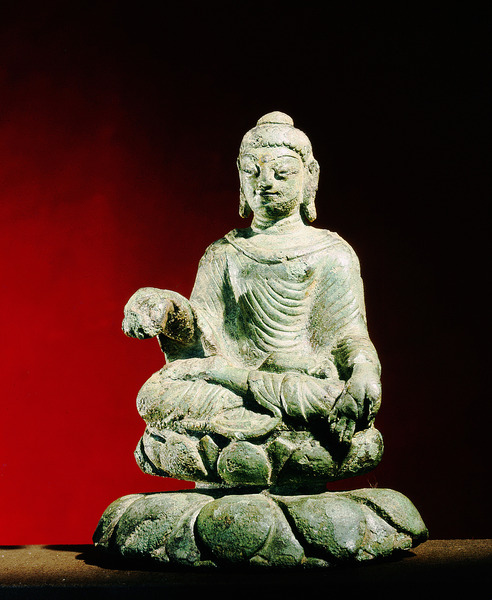
Figure of a Buddha from northern IndiaWe stress that the readings are not intended to be exhaustive or authoritative recommended bibliographies for the study of the Global Middle Ages. Instead they are compiled from suggestions that network participants make in advance of each workshop. They are designed to shape and stimulate discussion. The views expressed in works on these lists are not necessarily those of network members; nor are they intended to present a clear-cut case. We try as far as possible to find readings from all areas of the globe for each of the themes we discuss.
Historiography: Oxford
This workshop was the first in a series of four designed to discuss the scope, limits and nature of the global between c. 500 and 1600.
Periodisation: Birmingham
At the heart of this session was the question of how to distinguish a ‘Global Middle Ages’ from what came afterwards and (to a lesser extent) what came before.
Networks: Newcastle
This workshop, on ‘Networks’, was the third in our series designed to discuss the scope, limits and nature of the global Middle Ages between c. 500 and 1600.
Recording Cultures: Oxford
This workshop, on ‘Cultures of Recording’, was the fourth in our series designed to discuss the scope, limits and nature of the global Middle Ages between c. 500 and 1600.
Publication: Birmingham
This workshop was the fifth in our series. It differed from the other workshops in that it was explicitly dedicated to the detailed development of publication plans.
Outreach: Oxford
Why should I think about the Global Middle Ages and what will it do for me if I do?
This was the final workshop in our AHRC-funded series.
International Medieval Congress 2016, Leeds
Doing the Global Middle Ages: A Round Table Discussion
The very notion of a ‘global Middle Ages’ is controversial. Basic problems of definition, approach, and even ethics abound, with some scholars unsettled by the imperialist and euro-centric history of the term ‘medieval’. But this is a new and exciting field, certain to be shaped as much by practical experience as by theoretical foreboding.
International Medieval Congress 2017, Leeds
‘In Other Words: Redrawing Frameworks Using the ‘Global Middle Ages’ as Method’
Global medievalists seek meaning from positions within a context of globalised and post-colonial modernity, inescapably aware of troubling and persistent power relationships - economic, political, and intellectual - between Global North and South.
Medieval Zomias: Stateless Spaces in the Global Middle Ages: Oxford
An international workshop exploring James Scott’s concept of zomias and its relevance to the global middle ages was held in Oxford in February 2019.